

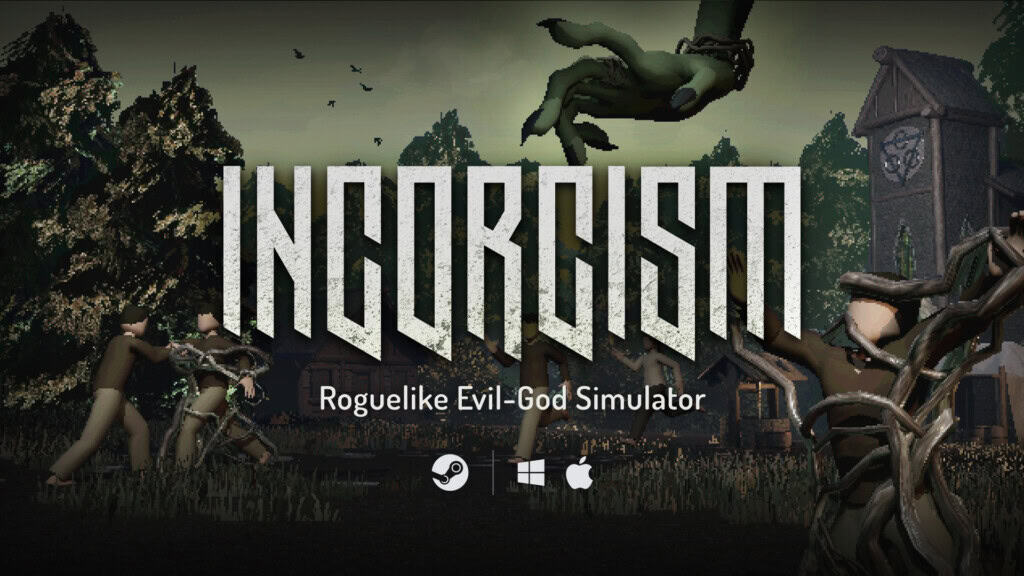
Despite being really popular during the late 90s and early 2000s, the god game is somewhat of a dying genre. The amount of self-described god games released in the last few years have been few and far between, especially when it comes to ones that let you play as evil gods. INCORCISM aims to rectify that, though. This new title, developed in collaboration by independent Austrian studios Nemwaz Softworks and HELLSENT GAMES, was unveiled on Kickstarter just a few days ago. It is described by its developers as a “roguelike strategy evil god simulator.” As this game’s malicious protagonist, players are tasked with watching over a lively village, learning about its inhabitants, and using over 30 different skills to corrupt each and every one of them.
INCORCISM isn’t exactly your run-of-the-mill strategy game, and that’s exactly why we found it quite interesting. To learn more about the upcoming title, Power Up Gaming sat down with game designer and art director Sascha Ulreich (head of HELLSENT GAMES) and asked him various questions.
The following transcript has been lightly edited for clarity.
For those unaware, tell us about what you do and describe your game for us.
Sascha: So, I’m Sascha and I’m the game designer of INCORCISM. The core idea [of this game] is we’re building an evil god simulator. You watch over a lively village in a forest, you learn about its villagers, you find their weak spots, and you choose from a selection of over 30 different skills to corrupt them from within.
The idea is that a sociable person who’s out a lot will carry a curse and spread it on contact throughout the whole village. Someone living in seclusion, for example, will respond more strongly to dark visions. You spread your corruption and, while doing so, you try to stay out of the priest’s sight. He’s your only foe and he will notice if something’s going on and he will pull up countermeasures, like regular villager checks or exorcisms. He might even burn your cultist on the funeral pyre.
So, think of INCORCISM as Plague Inc. but you actually play an evil god and you actually get to know your victims.
I kind of thought it was similar to Plague Inc., as well.
Sascha: Yeah, nice. It was the core inspiration. We went a lot deeper, though. We wanted to bring it down to a smaller scale, to a smaller scope. You just watch a village and you really, like, get to know the villagers and have to use their traits against them.
INCORCISM is a very unique looking game. I personally haven’t really seen any other title like it. From what I can tell, the studio making this game is comprised of a team of two, right?
Sascha: Exactly, yes. We have two more freelancers aboard, but the core team working on it full-time is me and Manuel Butter.
Cool, so how is it like developing a game in the current climate of the industry today, especially without the backing of a major publisher?
Sascha: I guess you’re talking about AI, so one disclaimer up front: our core rule is no user-facing content can ever be AI-generated. Nothing you actually see, hear, or read in the game is AI-generated. That’s something we put in front of everything. What we do use AI for is coding, testing, and bug fixes.
Sounds good. So, are there any other games you have previously worked on, or is this your first project?
Sascha: I’ve built smaller board games. I’ve built some video games, but just for fun, so nothing really to put out there. But I’ve been playing a lot. I’ve been a gamer for all my life, and I recently counted how many games I approximately played, and it’s about 500 to 700. That’s why I thought making one could be a good idea.

You started working on INCORCISM in April of this year. How far along is the game right now?
Sascha: Right now, INCORCISM’s game world has almost been finished. We focused on that as we decided pretty early to do a Kickstarter. If you decide on doing a Kickstarter, your plans are pretty laid out because you have to show the visuals, you have to get the idea through, and so it’s a lot of visual work. This is actually, like, contradicting in terms of game development because usually you want to build a prototype.
What we’ve been doing is focusing on the core concepts first. And we [really went through that, worked on rough prototypes, and then] went straight for the trailer as soon as we knew, ‘okay the core idea will work and it will be fun and we can later build on that.’
Then, we started building the Kickstarter and trailer. The real prototype in the closed alpha — not talking about the one you can get access to on Kickstarter — but the closed alpha will be done very soon. We’re starting with some real simulations now.
Will the Steam page go live soon?
Sascha: Yes, next week. It’s open in my other tab.
By the way, I think I mispronounced the name of your game. So it’s pronounced INCORCISM (in-sor-sism) instead of (in-kor-sism)?
Sascha: Yes. It’s difficult to find names nowadays, but we went for a fantasy name. The idea was that you usually do an exorcism, and the religious priest will also do an exorcism on your villagers. So, we’re doing an incorcism.
On your game’s FAQ page, you mentioned that INCORCISM will be available for Windows and Mac at launch, with a Linux port developed later. You also say that you don’t have plans to make console ports in the near future. But, if you do get the opportunity to make console versions, which platforms would you prioritise? Nintendo, PlayStation, or Xbox?
Sascha: I’m a huge PlayStation player, not going to lie. And I would love to see the game come to PlayStation. But I feel, as soon as we have the core concepts laid out for consoles, there’s nothing like really standing in the way of porting it to other consoles. The real culprit there is to make a [suitable control scheme] for the game on other platforms, because you don’t have a cursor on the console.
What inspired you to make this game?
Sascha: It was actually a very nice story. Manuel was working on a small project he wanted to finish — I remember him telling me this about two or three months ago — and he showed it to me and asked me what I thought about it. I was like, ‘it looks super cool.’ It was the same village but set on a mountainside, so it was all snowy and stuff. You were actually running around in the village, and it was about collecting things to build up ritual places.
Even back then, the core concept was kind of there. But, then, I asked him about some ideas. We talked about it, and then we came to this idea of an evil god simulator. We pulled inspiration from Plague Inc. and built the idea from there.

On its Kickstarter page, INCORCISM is described as an “outbreak simulator.” Is the gameplay sort of similar to spreading diseases as you do in, like, Plague Inc.?
Sascha: Yes, but you do it in a different way. Plague Inc. was just an inspiration and a place we went to for initial ideas or to mark concepts out. In that game, you have this total strategy feeling, you view the entire world [from up above]. Our game focuses on a place [far smaller in scope]. You have to do more stuff with the mouse, yet it’s not a turn-based game nor is it an RTS. It’s not StarCraft. It’s not super fast and you don’t have to be fast. Our goal is to make it playable with only a mouse. The keyboard will still be supported, though, because we love shortcuts.
Aside from Plague Inc. are there any other games you would compare INCORCISM to? Or do you think it’s something that’s completely unique?
Sascha: No, I don’t think that it’s completely unique, but it’s fun you asked because, a couple of days ago, someone mentioned to me on X that there’s a game called Black and White and there are 2 parts of it that were released around 2000.
Yep, it’s from Peter Molyneux, the guy who made Fable.
Sascha: Oh really? I didn’t know that. I haven’t looked into it very deeply, but I will for sure because it sounds like the exact type of game we’re doing. I feel like there was another one called Reus. It was quite big. It was also a god game, but to be fair, I don’t know a real evil god game. Actually, there’s one, but it’s way different. It’s called Ruinarch.
In INCORCISM, there are 10 game modifiers called Agony Levels. These can change how individual runs will work. You mentioned 5 of them on your Kickstarter page. Can you share what some of the others are, or do you want to keep them a secret?
Sascha: I would love to share them, but we don’t know yet. The core idea is just to have asymmetrical difficulty levels, like you may have seen in Slay the Spire with the Ascension levels. We really love unique modifiers that change not only how hard the game is — like, how hard it is to spread corruption — but also change the village layout. Let’s say, for example, that you had 2 churches in a single village or something.
I personally find this very interesting because, when a lot of games add high difficulty settings (especially FPS titles), they tend to just make all the enemies bullet sponges. I like when games try to add difficulty modifiers that are actually unique, instead of just making things a little bit more hard, you know?
Sascha: Yes, and it’s also a nice way to compensate some of the ideas we have because, there are many, many [potential game concepts out there], but we can’t incorporate all of them into the main gameplay. So that’s a way to bring in different — I don’t want to say game modes because it will still be the same goal and the same game — but rather just compensate for some of those ideas.
Like, what if there were 2 priests [instead of 1]?

What are some of the randomised traits that each villager can have in the game? Is there a specific amount of traits in INCORCISM, or are each of them procedurally generated?
Sascha: There’s a pool and the algorithm pulls from the pool. We’re aiming for 8 [of them]. We are certain on 5 to 6 [of these traits], but we’re testing those currently. But yeah, we’re aiming for 8, so it shouldn’t be too [complicated] — I don’t want to have to open a wiki next to it.
Can you share with us some of the skills that players can cast on villagers?
Sascha: Yes. One thing up front, we’re building skills by defining playstyles and then building skills around that. There are certain systems that need to be served in any playstyle. Like, you have to get knowledge about your villagers, but there are different ways to do that, and we’re currently working on 2 major playstyles.
We’re aiming for 4 playstyles [in total], but the 2 we’re currently talking about are the Mind Control tree and the Roots tree. The idea with Mind Control is that you can still play stealth. With it, you can use your cultists to infiltrate the village to get more information, to spread corruption, and to command them around with your mouse. I’d say that this is very active gameplay.
On the other hand, we have a rather loud playstyle, which is called Roots. And the Roots are essentially a system that basically grows to connectors. It starts from the forest [surrounding the village]. If you place a totem [in the village], then the roots will grow towards the totem and it will start spreading from there again.
We’re currently working out how the totems will [connect to each other and spread corruption further]. This will actually have an impact on the villagers, they’ll get corrupted from the roots growing around them and things like that.
Do you plan to launch the game into early access on Steam, or will it just be launched straight into 1.0?
Sascha: We will probably go for early access, but not because we want to see how it works. When we do a full publish, I want everything to be balanced. I want everything to be complete.
I don’t want to keep working on it afterwards if it’s not for a second part or a DLC. And saying that, I feel like we can only really guarantee that we won’t change anything more, until after we hopefully see hundreds or thousands of playtests to view how different exploits can work and have more ideas to work on.
Your Kickstarter page mentions that you’re thinking about adding more funny villager interactions to INCORCISM, such as villagers slapping each other, playing tricks on others, and singing in the bathtub. How much humour is in the game as a whole? Is there any other humour aside from this stuff, or are these funny interactions the only humorous aspect of the game?
Sascha: We want INCORCISM to take itself seriously, but we also want to add some humour. If you take time and zoom in to look at [the villagers] going around, we want you to have an occasional laugh.
Are there any narrative threads in the game? Does it have any kind of plot, or is it more focused on gameplay?
Sascha: It’s more focused on gameplay. We settled on the evil god idea, but there’s not yet a lot more to that. We’re drawing inspiration from the big ones. We’ve been reading a lot of Lovecraft and have tried to put in suiting or fitting assets, but we’re not planning on doing a whole story about it.
The aesthetic of the game does remind me a lot of H.P. Lovecraft, actually.
Sascha: Lovely, thank you.
As an aside, are there any games released this year that you’d like to give a shout out to?
Sascha: I recently backed a game on on Kickstarter called Bunderkin: The Ocular Eclipse, which seems very cool. But to be fair, I haven’t [checked out] many recent launches, as we’re doing our own launch right now.
Are there any other things you would like to mention?
Sascha: Yeah. You can get your name carved in an in-game tree if you fund our Kickstarter campaign. Maybe that’s something to shout out. Many people have loved the idea already. So, yeah, get your name carved in a tree!

